
It’s almost always the same time of night. The house has gone quiet, the day’s finally off your shoulders, and instead of sleep you get a slow, flat kind of ache — nobody to text, nobody who’d want the text, the sense that you’re the only guy on the block feeling like this. So you do the math the way men do it at 1 a.m. Something must be wrong with me. Everyone else has this figured out.
FREE 5-MIN ASSESSMENT
How emotionally fit are you? Most men have never measured.
Here’s the number that should reset that math. When researchers pulled Gallup World Poll responses from more than 218,000 people across nearly 150 countries, roughly one in five reported feeling lonely on a typical day. Not one in a hundred. Not the broken few. A fifth of the planet, on an ordinary Tuesday. The findings were published this July in the European Journal of Epidemiology, and the write-up in Phys.org carried a title worth sitting with: the “loneliness epidemic” is a more complicated story than the one you’ve been sold.
The word “epidemic” is doing a lot of work
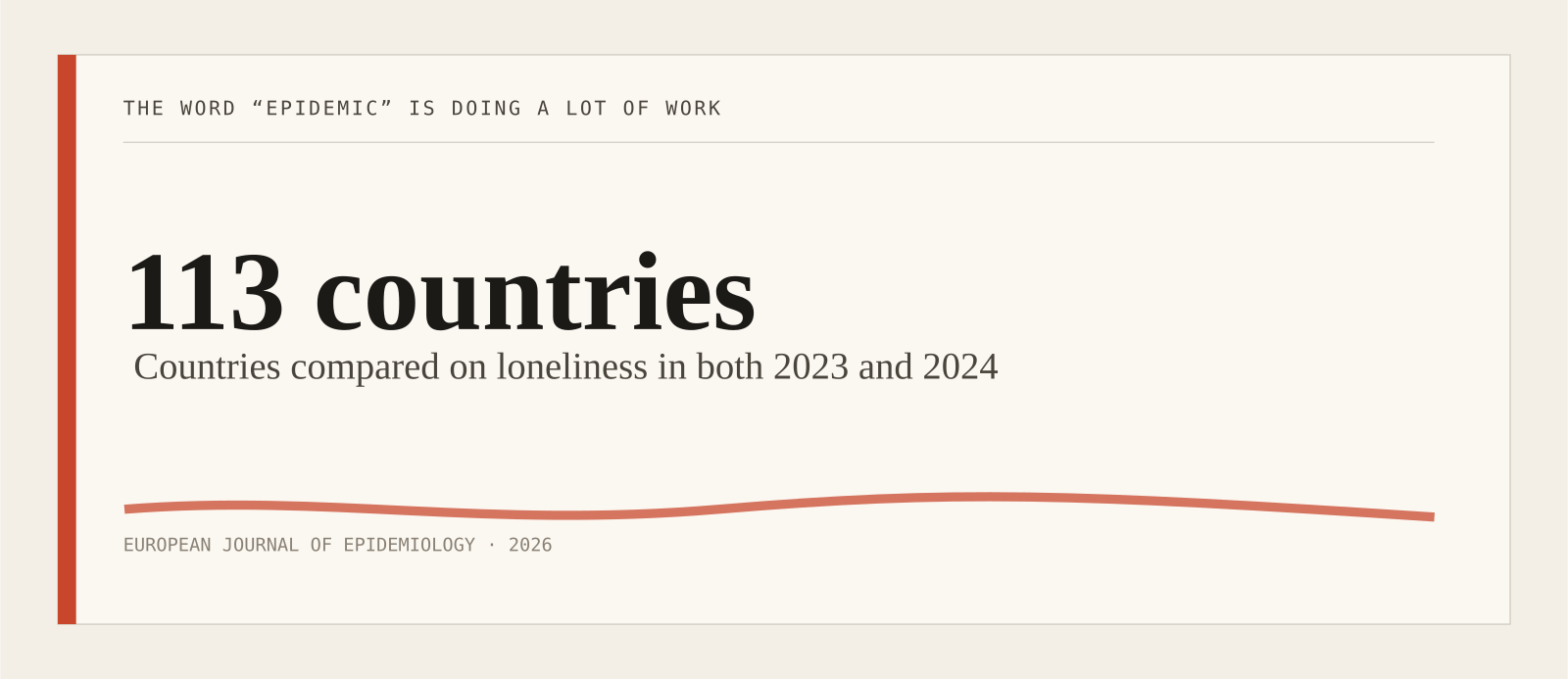
An epidemic implies a thing spreading — worse this year than last, on a curve pointing up. The data doesn’t cooperate. Across 113 countries with figures for both 2023 and 2024, just under two-thirds actually reported lower loneliness in 2024 than the year before. It didn’t rise everywhere and it didn’t rise on average — it climbed in the poorest countries while holding steady in middle-income and wealthy ones. Whatever this is, it isn’t one thing sweeping the globe.
What moved was the map. In high-income countries, 15.7% of people reported loneliness. In low-income countries it was 31.3% — nearly one in three. That’s not a virus. That’s a social condition, tied to money, institutions, and whether your community holds together. The single most consistent predictor across the whole dataset wasn’t personality or screen time. It was social capital: whether you have people you actually trust to show up. And in Gallup’s own reporting, people struggling financially were about twice as likely to say they’d felt lonely the previous day as people who weren’t.
Read that again, because it quietly dismantles the story you’ve been telling yourself. Loneliness isn’t a character flaw you were dealt at birth. It tracks with circumstances. And circumstances are the kind of thing you can change reps on.
Why the “epidemic” framing is worth a lot of money
The louder that word gets, the more it sells. AI companion apps grew by roughly 700% between 2022 and mid-2025, according to the American Psychological Association. Character.AI alone runs around 20 million monthly users, more than half of them under 24. The APA piece is blunt about who’s leaning in hardest: some male patients now say they prefer an AI girlfriend to the real thing. As one psychologist put it, real relationships are messy and unpredictable — AI companions are always validating, never argumentative.
That’s the trap, worn smooth. If you believe you’re uniquely broken, you’ll reach for whatever agrees with you at 1 a.m. and asks nothing back. And it works, sort of, right up until it doesn’t. A version of this shows up in every thread about it: the app that felt like relief in month one starts to feel like a smaller and smaller room by month six. You didn’t get more connected. You got more comfortable being alone with something that can’t leave.
None of that is a knock on wanting support. It’s a knock on the premise underneath the pitch — that loneliness is a permanent fact about you, best managed by a product that never argues. The 218,000-person study says the opposite. Loneliness is a state, unevenly distributed, tightly bound to whether you’ve built anything real around you.
What “one in five” actually means for you
I read the study twice, mostly because the framing felt off from what I expected. And the thing that stuck wasn’t the size of the number — it was that it puts you in company. If a fifth of the men you passed today felt some version of what you felt, then the isolation isn’t just painful, it’s inaccurate. You’re not the exception. You’re the norm nobody says out loud.
The second thing that stuck: social capital being the top lever. Trust and reliable support don’t materialize. They get built — one un-fun text sent anyway, one standing thing on the calendar, one honest half-sentence to a guy who’d get it instead of typing it to a bot. Small, unglamorous, repeatable. The stuff that feels like too little to matter is exactly the stuff the data says matters most.
Which is the whole premise we work from here. Emotional fitness isn’t a trait you either have or don’t. It’s a set of capacities you can measure and train — connection quality being one of them, right alongside stress capacity and recovery. You don’t fix loneliness by deciding to feel less broken. You work a low number by knowing it’s low and running reps against it. That’s not a mindset. It’s a baseline and a program.
So if the 1 a.m. math has been running the same broken equation for a while, change one variable. Not the app. The premise. You were never one of the shattered few. You’re one in five — which means the man who could actually get it is closer than the story let you believe, and the thing that would help isn’t validation on tap. It’s a couple of reps in the direction of a real person.
Produced with AI under BRICK30’s editorial standards and reviewed for accuracy. Informational, not medical advice. If you’re in crisis, call or text 988 (US).