
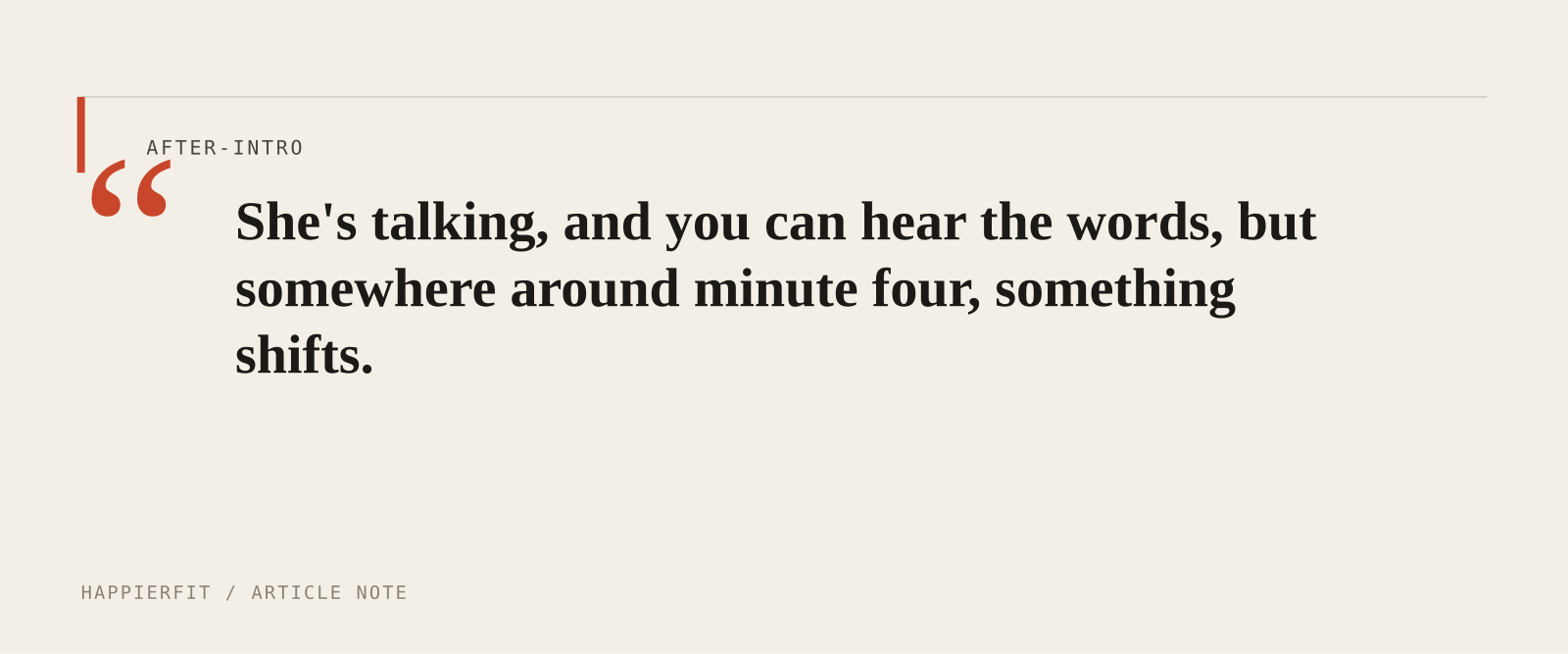
Picture this: You’re in the middle of a disagreement with your partner. She’s talking, and you can hear the words, but somewhere around minute four, something shifts. Your chest tightens. Your jaw locks. Your brain goes foggy. And the only thing that makes sense — the only thing that feels survivable — is to stop talking and wait it out.
So you go quiet.
From the outside, it looks like you don’t care. Like you’re punishing her. Like you’ve decided she’s not worth engaging. But from the inside? You feel like you’re barely holding it together.
This is what emotional shutdown actually looks like in men. And it’s not what most people think it is.
FREE 5-MIN ASSESSMENT
How emotionally fit are you? Most men have never measured.
Your Body Is Making a Decision You Didn’t Consciously Choose
The first thing to understand is that going silent during conflict often isn’t a strategy. It’s a physiological response.
Researcher John Gottman spent decades studying couples in conflict, and what he found about men’s bodies is striking. During heated arguments, men’s heart rates escalate faster and stay elevated longer than women’s. Once a man’s heart rate crosses roughly 100 beats per minute, his ability to process information, respond thoughtfully, or access empathy drops sharply. His body is in a stress response — and stonewalling is the behavioral output of that response, not a deliberate choice to punish or withdraw.
Gottman called this “diffuse physiological arousal,” and he observed it triggering shutdown in men at dramatically higher rates than in their female partners. The silence isn’t contempt. It’s overload.
What’s Happening in Your Brain When You Shut Down
Here’s the neuroscience in plain terms: you have two parts of your brain competing in that moment. The amygdala — the threat-detection center — is firing hard. It’s flooded with stress signals and it’s doing its job, which is to protect you from danger.
The problem is that your prefrontal cortex — the part responsible for rational thinking, language, and emotional regulation — gets taken offline when the amygdala floods (van der Kolk, 2014). This is why, in those moments, you literally cannot find the words. You’re not being evasive. The language centers of your brain are genuinely impaired.
Stephen Porges’ polyvagal theory adds another layer to this. When your nervous system perceives threat — even emotional threat — it can shift into a “freeze” or “shutdown” state, a survival response rooted deep in evolutionary biology. Silence, in this framework, is your nervous system hitting the emergency brake.
Why Men in Particular
The physiological piece explains the mechanism. But it doesn’t explain why men are so much more likely to end up here in the first place.
That part has more to do with how boys are raised.
From a young age, most men receive consistent messages that emotional expression carries social costs. Crying gets you laughed at. Admitting fear gets you called soft. Talking about pain makes you a burden. Over time, these lessons don’t just shape behavior — they shape the nervous system itself. You learn to suppress emotional signals early and often, which means by the time you’re an adult, you may have very little practice identifying or articulating what’s happening inside you.
Psychologist Ronald Levant has documented a condition he calls “normative male alexithymia” — a culturally conditioned difficulty in identifying and describing one’s own emotions that’s significantly more prevalent in men than women (Levant et al., 2009). This isn’t a character flaw. It’s a learned pattern, reinforced over decades. Many men genuinely don’t know what they’re feeling in the heat of a moment — and so silence becomes the default because language fails them.
You can read more about how this plays out day-to-day in our piece on emotionally unavailable men and why that label often misses the actual cause.
What Your Partner Is Experiencing on the Other Side
Here’s the part that matters if you’re in a relationship where your silence has become a recurring flashpoint: your partner almost certainly doesn’t read your shutdown the way it feels from the inside.
When you go quiet, what she typically experiences is rejection. Or contempt. Or the terrifying feeling that she’s losing you and can’t reach you. Gottman’s research identifies stonewalling as one of the four most destructive patterns in relationships — not because men who do it are dangerous people, but because unaddressed, it erodes emotional intimacy men and women both desperately need.
She’s reaching for connection. You’re overwhelmed and trying to survive. Both things are true. And the gap between those two experiences — when it goes unspoken — becomes a wall.
The “Strong and Silent” Trap
There’s a cultural story most men absorb without realizing it: that being quiet under pressure is strength. Stoicism as virtue. Keeping your head when everyone around you is losing theirs.
And there’s something real in that. Composure matters. But somewhere along the way, “strong and silent” got confused with “emotionally unavailable,” and a lot of men ended up isolated in plain sight — present in the room but unreachable.
The men who seem most resilient aren’t the ones who never feel overwhelmed. They’re the ones who’ve learned to name what’s happening, even imperfectly, before they disappear into it. That’s a skill. And like most skills, it can be learned — but only if you recognize why men don’t talk about feelings isn’t a personality trait but a gap in emotional vocabulary that was never filled.
The Gap Between What You Feel and What You Can Say
Research consistently shows that men score higher on alexithymia measures — difficulty identifying and communicating feelings — than women (Levant et al., 2009). This isn’t about intelligence or caring. It’s about a specific kind of fluency that many men were never taught to develop.
In a conflict, when your partner asks “what are you feeling right now?” and you genuinely don’t know — not because you feel nothing, but because the internal signal and the words to describe it never got connected — silence is the honest answer. It just doesn’t come across that way.
This is one of the reasons therapy for men, when it’s done right, focuses less on talking about feelings in the abstract and more on building the vocabulary to identify them in real time. If that’s something you’ve been curious about but never acted on, the article on therapy for men walks through exactly what to expect and why it works differently than most men assume.
What to Do Instead of Disappearing
The goal isn’t to push through a conversation when your nervous system is flooded. That backfires — you’ll either say things you don’t mean or shut down harder. Gottman’s own research recommends a physiological self-soothe break of at least 20 minutes before re-engaging.
But there’s a crucial difference between taking space and going silent without explanation.
“I need 20 minutes to calm down, and then I want to talk about this” lands completely differently than disappearing into another room or picking up your phone. One is a bid for regulation. The other, from your partner’s side, feels like abandonment.
This single shift — learning to name the process even when you can’t name the feeling — is one of the most practical things men can do. It doesn’t require fluency in emotional language. It just requires honesty about what your body is doing.
If you want to understand the broader pattern of why men don’t ask for help — in relationships, in health, in mental health — that piece connects directly to this one and fills in some of the why behind the silence.
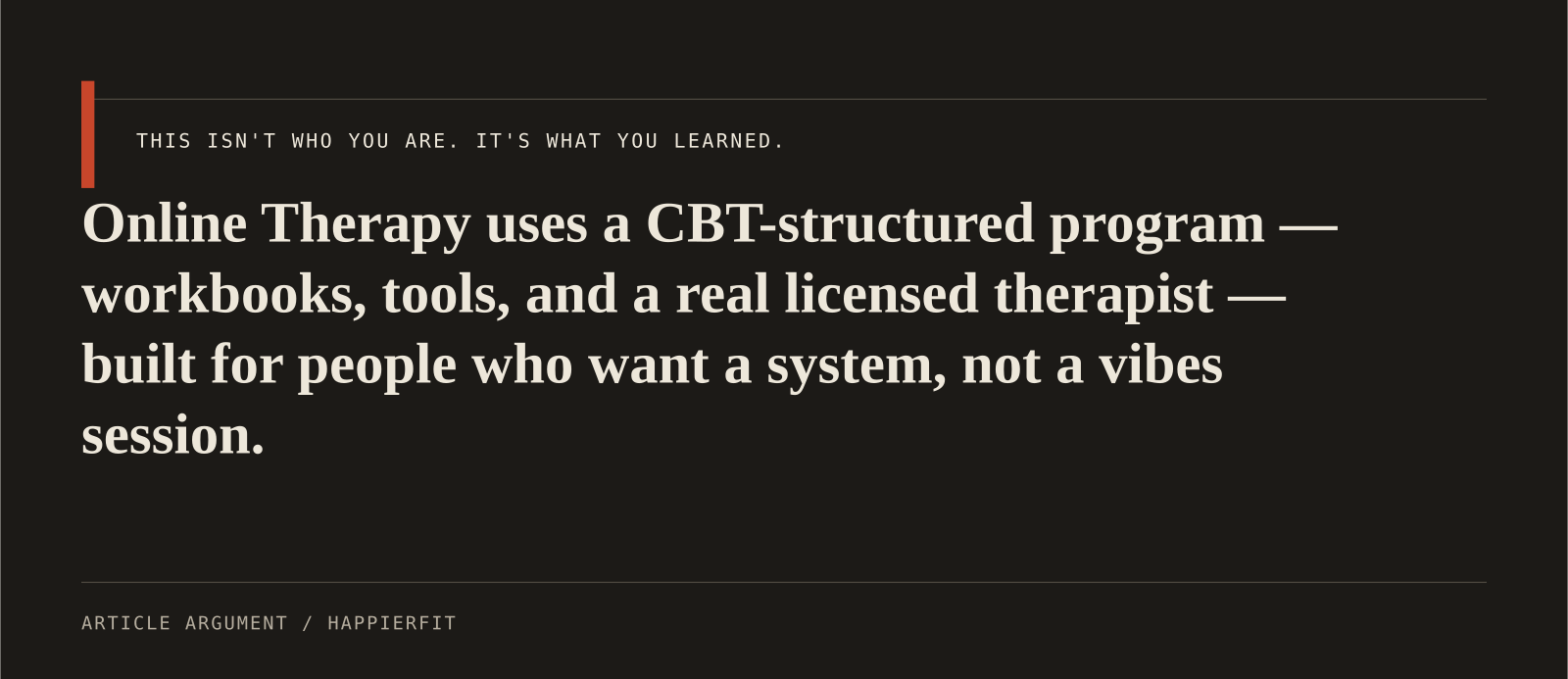
This Isn’t Who You Are. It’s What You Learned.
The silence that protects you in conflict was adaptive once. It helped you survive environments — classrooms, locker rooms, households — where vulnerability wasn’t safe. That’s not a character flaw. That’s intelligence operating under constraints.
But the environments have changed. The person in front of you isn’t the kid who laughed at you for crying or the parent who told you to toughen up. She’s trying to reach you. And you probably want to be reachable — you just don’t always know how.
That’s the whole point of translating these behaviors: not to pathologize men for doing what they were taught, but to offer a better map. One that shows you where the silence actually comes from, so you can choose something different when it matters.
If the silence is becoming a wall between you and the people you love, Online-Therapy.com offers discreet, flexible therapy designed to fit your life. You can meet with a licensed therapist from your phone, on your schedule — no waiting rooms, no awkward explanations. It’s built for people who’ve never done therapy before, and for people who have.
References
Gottman, J. M., & Levenson, R. W. (1988). The social psychophysiology of marriage. In P. Noller & M. A. Fitzpatrick (Eds.), Perspectives on marital interaction (pp. 182–200). Multilingual Matters.
Gottman, J. M., & Silver, N. (1999). The seven principles for making marriage work. Crown Publishers.
Levant, R. F., Hall, R. J., Williams, C. M., & Hasan, N. T. (2009). Gender differences in alexithymia. Psychology of Men & Masculinity, 10(3), 190–203.
Porges, S. W. (2011). The polyvagal theory: Neurophysiological foundations of emotions, attachment, communication, and self-regulation. W. W. Norton & Company.
van der Kolk, B. (2014). The body keeps the score: Brain, mind, and body in the healing of trauma. Viking.
Free: read one full protocol chapter
Seven real pages from the Emotional Fitness Playbook: Chapter 7, the Return-to-Baseline Protocol, and its printable worksheet. A PDF you can open right now.
No email needed.
JOIN THE DISCUSSION
Caregiver Burnout — The Physical Symptoms Nobody Talks About — share what’s working for you.
Ready to do the work?
Online Therapy that actually fits how men think.
If you’ve read this far, you’re past the part where “talk to someone” sounds patronizing. Online Therapy uses a CBT-structured program — workbooks, tools, and a real licensed therapist — built for people who want a system, not a vibes session. Sessions on your schedule, no waiting room, no copay games.
Start with a free assessment →
Disclosure: HappierFit may earn a commission if you sign up. Online Therapy operates in 30+ countries with licensed clinicians.