
Financial stress is the leading stressor for American men between 30 and 55 in 2026. That’s not a take. That’s what the surveys keep finding, year after year, regardless of the economy. Men carry it differently than the data captures — quietly, in ways that look like irritability or withdrawal or working too late, until it doesn’t stay quiet anymore.
FREE 5-MIN ASSESSMENT
How emotionally fit are you? Most men have never measured.
This is not an article about budgeting apps. I’m not going to give you a list of ten tools to download.
What I want to talk about is something narrower: using AI — specifically Claude and Gemini, both free, no credit card — as a thinking partner when the financial situation is genuinely stressful and your brain is in threat mode.
Because here’s what happens when you’re under real financial pressure. Your prefrontal cortex, the part responsible for planning and decision-making, essentially throttles. You’re running on stress hormones. The instinct is to either compulsively research everything or avoid everything, sometimes alternating between both in the same afternoon. Neither helps.
What does help is having somewhere to think out loud — somewhere that won’t judge you, won’t panic alongside you, and will help you get clear.
What AI Is Good For Here (And What It’s Not)
Let me be honest about the limits first. AI doesn’t know your actual financial situation unless you tell it. It can’t pull your bank statements. It doesn’t know your tax filing status or whether your 401k has a match. It makes mistakes with math if you give it complex scenarios — always double-check the numbers yourself or with a human professional.
What AI is genuinely good at is helping you think. Translating jargon. Breaking down options. Helping you see a decision from multiple angles. Preparing you for a hard conversation. Organizing the mess in your head into something you can actually act on.
No app to sign up for. No subscription. Just open Claude at claude.ai or Gemini at gemini.google.com on your phone or laptop. Both are free. Both are capable enough for this.
A Worked Example: $24,000 in Credit Card Debt
Let me show you what this actually looks like.
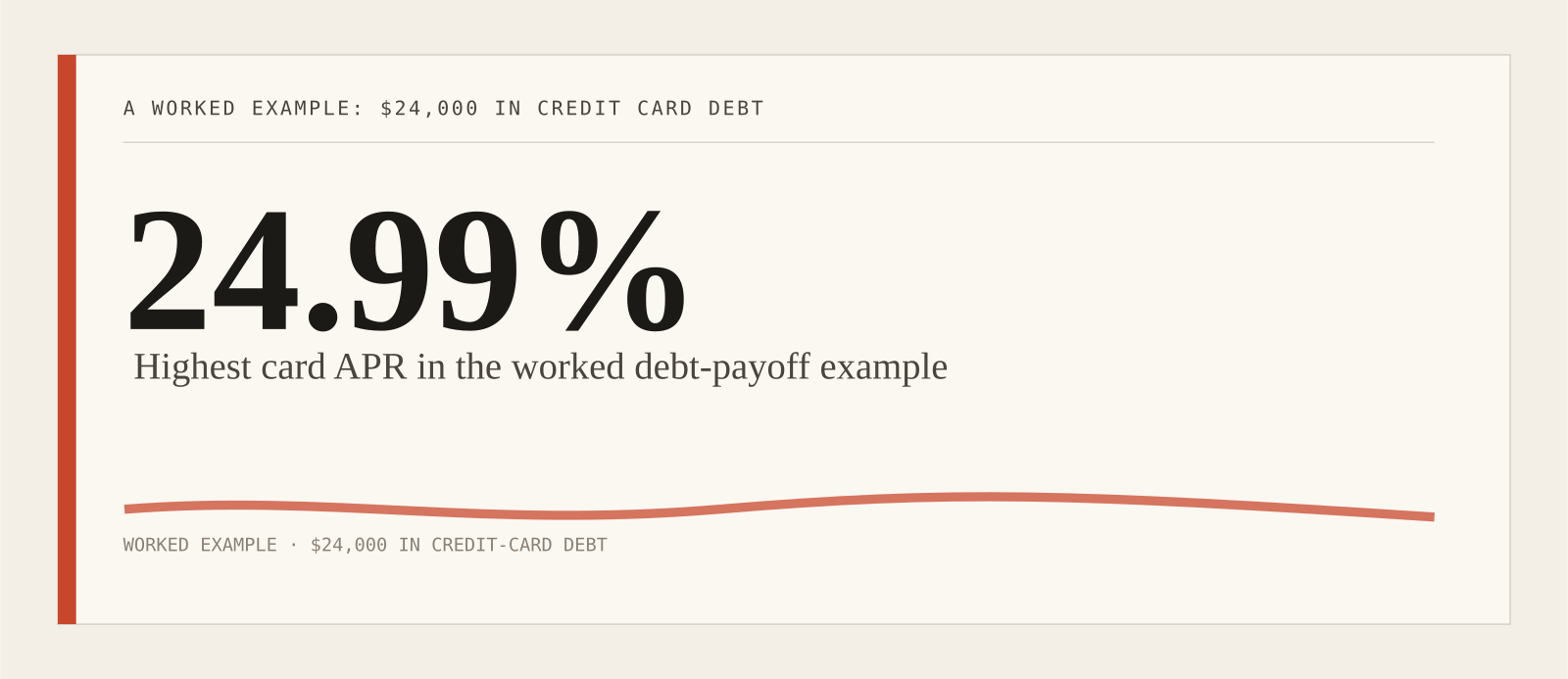
Say you’re carrying $24,000 in credit card debt. Three cards — $11,000 at 24.99% APR, $8,500 at 21.99% APR, $4,500 at 18.99% APR. You have $600 a month that could go toward this, after minimum payments.
A lot of men in this situation know they’re in trouble but can’t see the shape of it clearly. They don’t know whether to consolidate, whether to call the card companies, whether the avalanche method is actually that different from just paying them down one at a time. The stress makes it hard to think through systematically.
Here’s the kind of thing you’d actually type into Claude:
“I have $24k in credit card debt across three cards: $11k at 24.99%, $8.5k at 21.99%, $4.5k at 18.99%. I can put $600/month toward this beyond minimum payments. Can you show me what the avalanche payoff would look like versus the snowball method, roughly how long each would take, and how much interest I’d save with avalanche?”
Claude will walk you through both. The avalanche method — highest interest rate first — typically saves the most money. On the numbers above, rough difference in total interest paid is somewhere around $1,800-$2,200, and avalanche gets you done a few months faster. The snowball method — smallest balance first — is faster in terms of early wins, which matters for motivation.
Neither one is objectively correct for every person. That’s the kind of nuance a thinking partner can help you work through.
Then you might follow up: “What are the realistic options for someone in this situation? I’ve heard about balance transfer cards and personal loans. What are the actual tradeoffs?”
And Claude can explain: a balance transfer to a 0% APR card (if you qualify — and that’s a real if) can save significant interest but usually has a 3-5% transfer fee and requires good credit. A personal loan might consolidate at 10-15% APR instead of 22-24% but adds an origination fee and a hard credit inquiry. Calling the card company directly to ask for a rate reduction sometimes works and costs nothing to try — about 70% of cardholders who call and ask get some kind of accommodation, according to consumer credit research.
This is the kind of information that’s available online but hard to find synthesized clearly when you’re stressed and scanning 40 tabs.
You’d also want to ask: “What should I know about the tax implications of debt forgiveness if I went the settlement route?” Because that’s a real thing people don’t know — debt settled for less than you owe is typically taxable income, and that can be a nasty surprise.
The AI doesn’t replace a financial counselor. But it gets you to a conversation with a financial counselor already knowing the vocabulary and the options — which makes that conversation dramatically more useful.
Translating Financial Jargon
One of the quiet ways financial stress compounds is that the financial system is full of language designed to obscure rather than clarify. APR versus APY. “Up to” interest rate offerings. What “minimum payment” is actually doing to your balance long-term.
This is genuinely where AI earns its keep. You can paste in any financial document — a loan agreement, a 401k summary plan description, a mortgage modification offer — and ask “explain this to me in plain language” or “what are the parts of this I should actually worry about?”
People do this with Social Security statements, with disability insurance policies they’ve been paying for for years without understanding, with IRS notices that terrify them. The AI can’t give you legal advice. But it can usually tell you what a document says, what the key terms mean, and what questions to ask the actual professional.
Preparing for the Hard Money Conversation
The second most common place financial stress causes real damage is in relationships. Money is the leading cause of conflict in partnerships, and the conversations that need to happen often don’t — or happen badly, in crisis mode, when someone’s already scared or angry.
If you need to have a hard money conversation with a partner — about debt you’ve been carrying alone, about a career transition you’re considering, about the fact that the household budget isn’t working — AI can help you prepare in a way that’s genuinely useful.
Not “write a script for me.” But “I need to tell my partner that we have less saved than they think we do, and I’ve been avoiding this for six months. Help me think through what I actually want to say, what I’m scared of, and how to start.”
You end up doing the thinking. The AI just holds the structure while you do it. That’s different from having someone else write your words.
Modeling a Career Transition
One more use case worth naming: if you’re considering changing jobs, going freelance, or taking a step that involves real financial uncertainty, AI is useful for running through scenarios.
“I’m currently making $87k as a project manager. I’m considering going independent. I have $22k in savings. Walk me through what I’d need to cover: health insurance, quarterly estimated taxes, the 6-month runway question, what my effective hourly rate would need to be to match take-home.”
Claude will engage with this seriously and give you a starting framework. Not a final answer — you’d still want an accountant or a financial planner for that — but enough to know whether the idea is in the neighborhood of feasible before you invest a lot of emotional energy in it.
The Thing I Want to Say Directly
There’s a specific kind of shame that comes with financial difficulty — different from other kinds of stress, more isolating, harder to talk about. Men in particular tend to carry it alone, because asking for help with money still feels like admitting a kind of failure that the script says you’re not supposed to admit.
Using a free AI tool to think through your options is not failure. It’s using what’s available. The information has always been out there — it was just hard to access, jargon-heavy, or gated behind a professional relationship you couldn’t afford.
I’m not suggesting this replaces professional financial advice when you need it. It doesn’t. But I am saying: if the stress is making it hard to think clearly, and you can’t get to a planner or counselor right now, having something to think out loud with can break the loop enough to let you act.
No app. No subscription. Just a conversation. Start there.