
He replays it in the car on the way home. The meeting where he stumbled over his words. The argument with his partner where he said the wrong thing — again. By the time he pulls into the driveway, the replay has become a verdict: You’re weak. You always screw this up. What’s wrong with you?
FREE 5-MIN ASSESSMENT
How emotionally fit are you? Most men have never measured.
He doesn’t call it depression. He calls it being hard on himself. He calls it holding himself accountable. He calls it the thing that keeps him from getting soft.
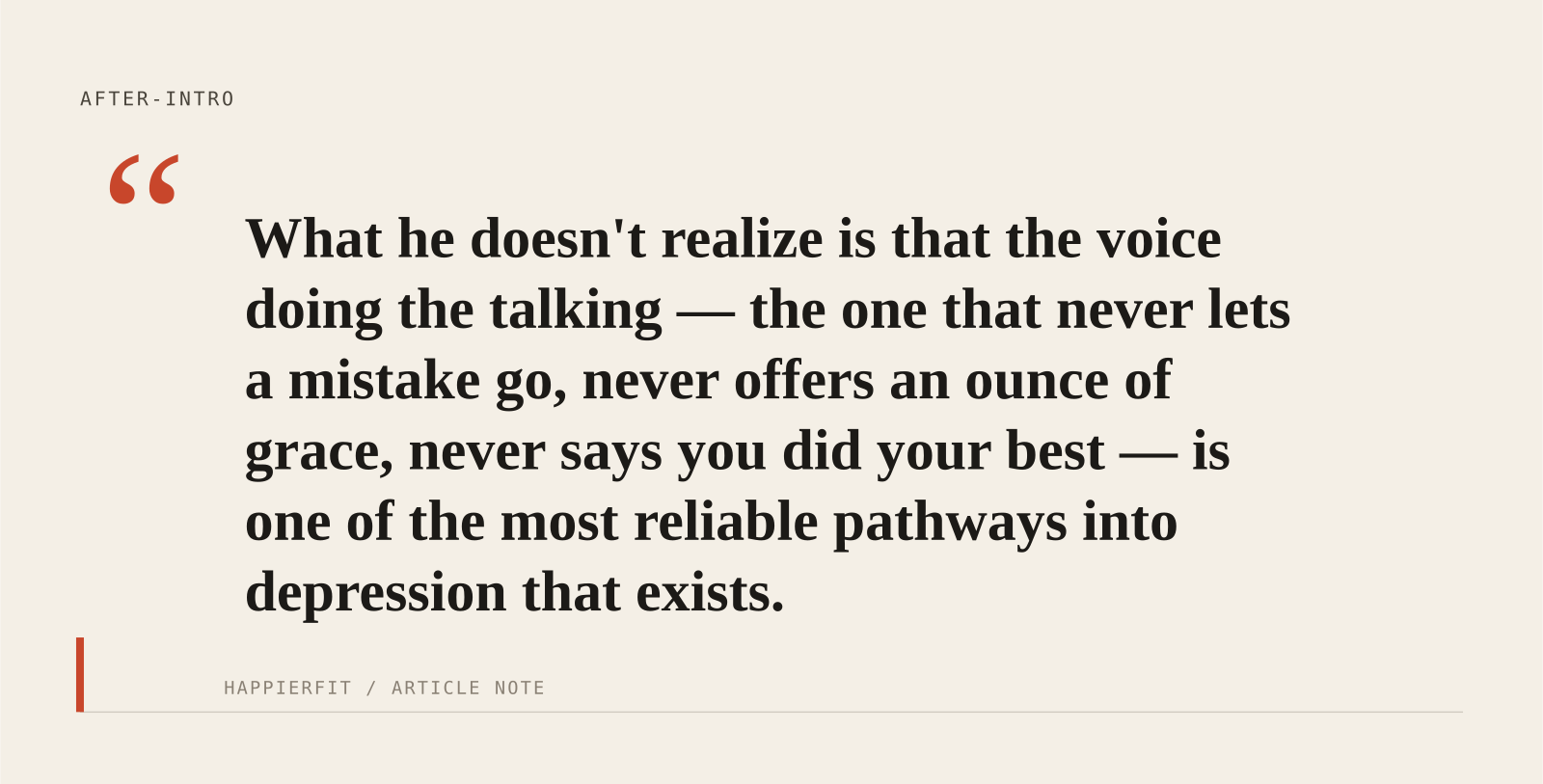
What he doesn’t realize is that the voice doing the talking — the one that never lets a mistake go, never offers an ounce of grace, never says you did your best — is one of the most reliable pathways into depression that exists. Not the kind of depression that looks like sadness. The kind that looks like a man who’s exhausted, irritable, disconnected, and quietly convinced he’s failing at everything.
This is the psychology of self-directed anger in men. And understanding it might be the most important thing a man can do for his mental health.
What Self-Directed Anger Actually Is
Anger is typically understood as something aimed outward — at a situation, a person, an injustice. But anger can just as easily turn inward, and when it does, it doesn’t announce itself clearly.
Self-directed anger shows up as self-criticism so harsh it would be unrecognizable if directed at a friend. It shows up as rumination — the inability to stop replaying failures, embarrassments, or perceived shortcomings. It shows up as self-blame that goes far beyond taking responsibility, tipping into self-punishment. And it shows up as a kind of chronic low-grade contempt for oneself that colors every interaction and decision.
Research by Tangney and Dearing (2002) drew an important distinction between guilt and shame — and the finding matters here. Guilt says I did something wrong; shame says I am something wrong. Guilt, paradoxically, is adaptive — it motivates repair. Shame, which is what chronic self-directed anger typically feeds, is destructive. It doesn’t motivate change. It motivates hiding, withdrawal, and further self-attack.
For men, the experience of shame as a hidden driver of depression and anger is particularly underexplored. Many men have been taught that shame is weakness, so they convert it quickly into anger — often toward themselves before anyone else can direct it at them. The self-attack becomes a kind of preemptive strike.
The Inner Critic as Depression Mechanism
Not all critical self-reflection is harmful. Honest self-assessment — the kind that says that approach didn’t work, I’ll try something different — is healthy and adaptive. The inner critic is something different. It is relentless, disproportionate, and immune to evidence.
Gilbert and Irons (2004) identified self-criticism as a clinically significant predictor of depression, distinct from low self-esteem. Their research found that self-criticism activates threat-based emotional systems — the same systems activated by external threat or attack — and that chronically self-critical individuals struggle to access the self-soothing, affiliative emotional systems that buffer against depression. In other words, the inner critic doesn’t just make men feel bad. It shuts down the neurological circuitry that would otherwise help them recover.
Shahar et al. (2012) extended this work, demonstrating that self-criticism mediates the relationship between negative life events and depressive symptoms. When something goes wrong, self-critical individuals don’t just feel the pain of the event — they compound it with a layer of self-attack that deepens and prolongs the emotional wound.
The mechanics look like this: a man makes a mistake or faces a setback. The inner critic activates. Self-blame amplifies. Rumination begins — the event gets replayed, dissected, used as evidence of fundamental inadequacy. The body stays in a state of stress activation. Sleep suffers. Motivation collapses. Connections with others feel undeserved or burdensome. The depression that follows doesn’t look like weeping. It looks like a man who has quietly decided, at some level, that he doesn’t deserve much.
Why Men Are Particularly Vulnerable
The inner critic is not a male-only phenomenon. But masculine socialization creates specific conditions that make self-directed anger more likely to become entrenched and more likely to go unaddressed.
Levant (1992) described what he called normative male alexithymia — a difficulty identifying and expressing emotions that is not innate but trained into boys through cultural messaging about what men are supposed to feel and show. Boys learn early that vulnerability is dangerous, that needing help is weakness, and that emotions other than anger or stoicism are suspect.
What this produces, in many men, is a narrow emotional vocabulary. When something goes wrong and the resulting feelings — sadness, fear, shame, grief — have no acceptable outlet, they don’t disappear. They convert. And one of the most common conversion products is self-directed anger. The man who cannot grieve a failure because grief feels weak will attack himself instead. The man who cannot acknowledge fear will punish himself for having been afraid.
This is compounded by cultural narratives around male self-sufficiency. A man who struggles is supposed to figure it out himself, push harder, do better. The natural response to difficulty — reaching out, processing emotions, seeking support — is coded as failure. The inner critic is, in many ways, an internalized version of these cultural expectations. It is the voice of a culture that never gave a man permission to simply be human.
For men who also struggle with perfectionism and the anxiety it drives, the dynamic intensifies. The perfectionist’s inner critic doesn’t just respond to actual failures — it responds to anything short of an impossible standard, which means it is almost always running.
The Rumination Loop
One of the most damaging features of self-directed anger is that it is self-sustaining. Psychologists describe a rumination loop: the inner critic produces self-attacking thoughts, those thoughts produce distress, the distress produces more rumination, and the rumination produces more self-attack.
Men are sometimes assumed to be less prone to rumination than women, but research complicates this. Men who have been socialized to suppress emotional expression may ruminate internally while showing little of it externally. The shutdown presentation — the man who seems fine, maybe distant, maybe a little irritable — often conceals an active rumination loop that has been running for months or years.
What makes the loop particularly hard to exit is that self-criticism can feel like responsibility. A man who is attacking himself believes, at some level, that he is doing something useful — holding himself accountable, ensuring he doesn’t make the same mistake twice. The idea that this self-attack is actually making things worse, not better, runs counter to everything he has been taught about self-improvement.
The research is clear, though. Chronic self-criticism does not produce better outcomes. It produces worse ones. It narrows thinking, reduces cognitive flexibility, increases avoidance behavior, and deepens depression. The man who is hardest on himself is not the one who performs best. He is the one who burns out, withdraws, or breaks down.
Self-Compassion as the Counterweight
The evidence-based response to self-directed anger is not positive thinking, affirmations, or simply trying to feel better about oneself. It is self-compassion — and it is not what most men think it is.
Neff (2003) defined self-compassion along three dimensions: self-kindness (treating oneself with the same care one would offer a friend in pain), common humanity (recognizing that struggle and imperfection are universal experiences, not personal failures), and mindfulness (acknowledging painful emotions without over-identifying with them or suppressing them).
Critically, Neff’s research found that self-compassion is not correlated with reduced motivation or lower standards. Self-compassionate people are not soft on themselves — they are honest with themselves without being cruel. They acknowledge mistakes, learn from them, and move on rather than replaying them indefinitely.
For men who associate self-compassion with weakness, reframing it as emotional efficiency is sometimes useful. The inner critic does not produce results. It produces paralysis, rumination, and depression. Self-compassion is the more effective operating system — it processes the error, extracts the lesson, and moves forward. The inner critic loops indefinitely.
The path into self-compassion for many men runs through understanding what the inner critic is actually doing. It is not protecting them. It is not keeping them sharp. It is a threat-response that was shaped by early experiences — of criticism, conditional love, high-stakes performance environments — and that has outlasted any usefulness it may once have had. Understanding how self-compassion works as a counterweight to the inner critic is one of the more practical steps a man can take.
When to Get Support
The combination of self-directed anger, a relentless inner critic, and untreated rumination is a well-documented depression pathway. If any of the following describe your experience, it is worth taking seriously:
- You replay mistakes or embarrassments frequently, often for days or weeks
- Your self-talk would be unrecognizable if you said it to a friend
- You feel fundamentally inadequate, not just that you did something inadequately
- You use self-criticism as a motivational strategy but it leaves you more depleted, not less
- You feel disconnected, exhausted, or like you’re performing okayness while something is quietly wrong inside
These are not character flaws. They are patterns — and patterns can be changed.
If you want a clearer picture of where you stand, the Men’s Emotional Health Score is a free 20-question tool built specifically for men. It takes five minutes and gives you a concrete baseline on where your emotional health is functioning well and where it’s under strain.
For men who are ready to work with someone, Online-Therapy.com offers structured, therapist-guided support that includes cognitive behavioral tools specifically designed to interrupt rumination loops and retrain the inner critic. It works around your schedule and does not require you to walk into an office and explain yourself from scratch.
The Shift Worth Making
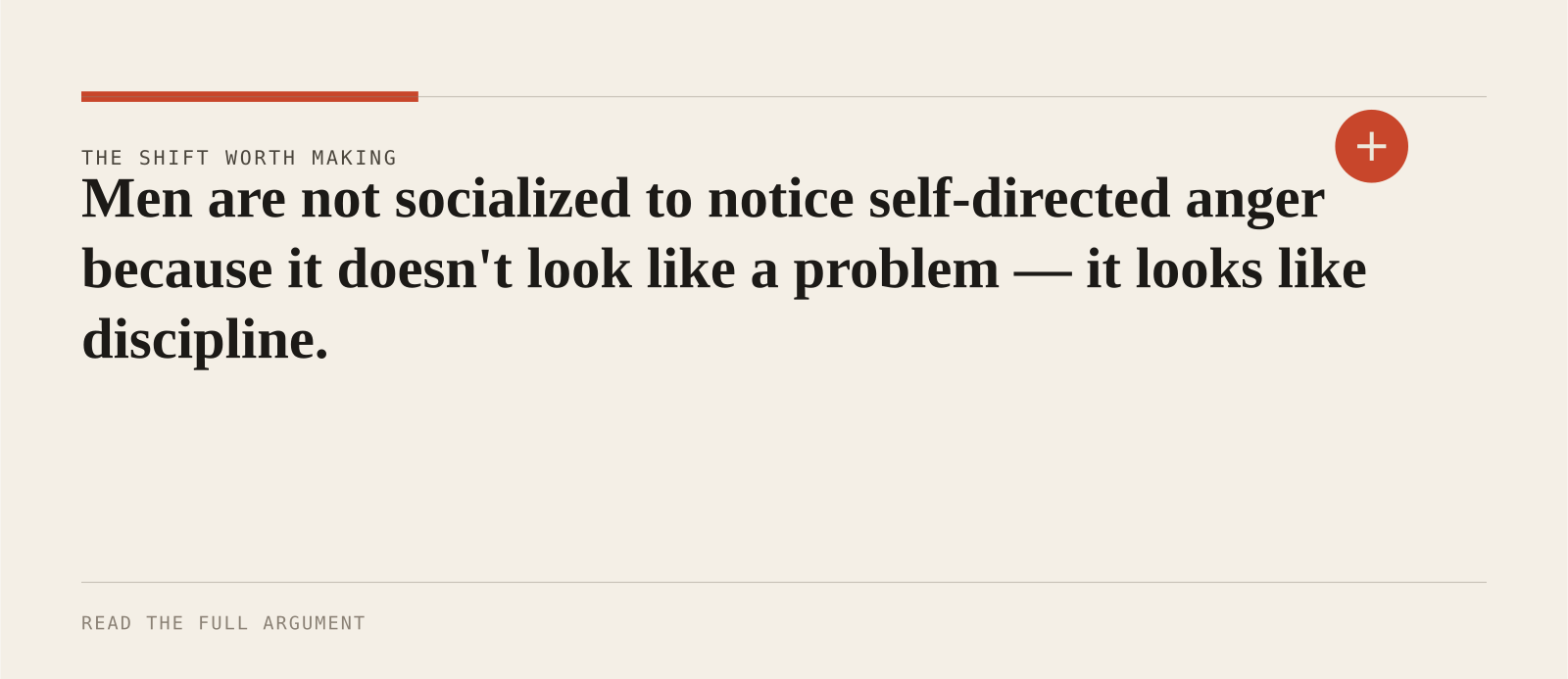
Men are not socialized to notice self-directed anger because it doesn’t look like a problem — it looks like discipline. The man who is hardest on himself often believes he is the most serious, the most accountable, the most motivated person in the room.
But the inner critic is not discipline. It is a closed loop that produces suffering and calls it standards.
The shift — from relentless self-attack to honest, compassionate self-assessment — is not a shift toward softness. It is a shift toward accuracy. Toward seeing yourself the way a trusted friend would: with full knowledge of your failures and full acknowledgment of your humanity.
That shift does not happen automatically. It takes work, often with help. But for men who have spent years in the grip of self-directed anger, it is some of the most important work they can do.
References
- Gilbert, P., & Irons, C. (2004). A pilot exploration of the use of compassionate images in a group of self-critical people. Memory, 12(4), 507–516.
- Neff, K. D. (2003). The development and validation of a scale to measure self-compassion. Self and Identity, 2(3), 223–250.
- Tangney, J. P., & Dearing, R. L. (2002). Shame and Guilt. Guilford Press.
- Levant, R. F. (1992). Toward the reconstruction of masculinity. Journal of Family Psychology, 5(3–4), 379–402.
- Shahar, B., Carlin, E. R., Engle, D. E., Hegde, J., Szepsenwol, O., & Arkowitz, H. (2012). A pilot investigation of emotion-focused two-chair dialogue intervention for self-criticism. Clinical Psychology & Psychotherapy, 19(6), 496–507.