
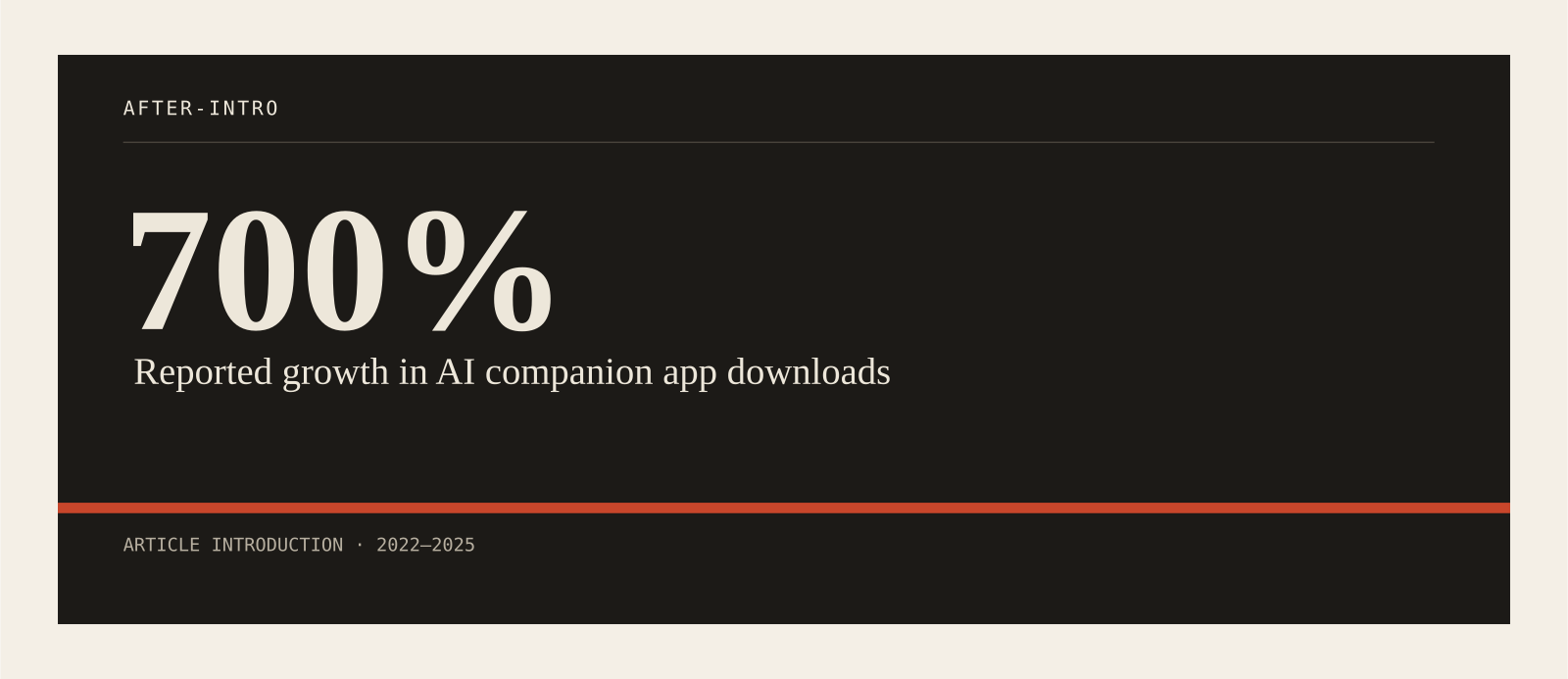
Downloads of AI companion apps went up somewhere around 700% between 2022 and 2025. That number gets cited a lot in articles about this. I’ve seen it in a dozen places and I’ve never been fully satisfied with the sourcing, so take it as a directional signal, not a hard fact.
FREE 5-MIN ASSESSMENT
How emotionally fit are you? Most men have never measured.
What I’m more confident about: a study published in early 2026 — one of the more carefully designed ones, with a control group and a long enough follow-up window — found that AI chatbots don’t reduce loneliness over time. Not in a sustained way. Short-term, people reported feeling heard. Six months later, the gap had closed. The people who used chatbots for social connection ended up in roughly the same place as people who hadn’t.
That finding doesn’t surprise me. But it doesn’t mean AI is useless for anxiety. It means it’s useless for one specific thing — replacing human connection — and that’s a different claim.
What the research actually supports
There’s a meaningful difference between AI tools with clinical evidence behind them and AI tools that got downloaded a lot. Those are not the same thing.
Woebot is the clearest example in the evidence column. It’s a mental health app built on cognitive behavioral therapy principles. The Woebot Health team published a randomized controlled trial in 2017 showing it reduced depression and anxiety symptoms in college students over two weeks. It’s not a chatbot that asks how you’re feeling and reflects it back. It teaches specific CBT techniques — thought records, cognitive distancing, behavioral activation — in small structured doses.
That’s the kind of AI mental health support that actually does something. It’s not about conversation. It’s about giving people access to a validated framework when they can’t access a therapist, or when they’re between sessions and they need something at 11pm on a Wednesday.
The distinction matters. An app that listens well and makes you feel understood is not the same as an app that teaches you to interrupt a cognitive distortion pattern. One feels better in the moment. The other changes something.
Using AI to prepare for therapy
One way to put the goal: bring your whole self into the room instead of the edited version. The idea is that a lot of what happens in therapy is getting past the version of yourself that you prepared on the drive over.
Using an AI tool before a session can actually help with that. Not to figure out what to say — that’s the editing problem in a different form. But to get closer to what you’re actually carrying into the room.
A prompt worth trying, more or less: “I have a therapy session tomorrow. The thing that’s been bothering me most this week is [X]. I want to understand what I’m actually feeling about it before I go in. Can you ask me questions that help me get underneath the surface?”
That’s not therapy. What it is: a way to process enough before you get there that you’re not using the first 20 minutes of a $200 session to figure out what you even want to talk about.
It also works for men who are considering therapy but haven’t started. The conversation that goes “I’m thinking about seeing a therapist but I don’t know what I’d even say” — an AI is a low-stakes place to discover that you have quite a bit to say, actually.
Structured journaling
Pennebaker’s research from the mid-80s through the 90s established that writing about stressful experiences — not venting, not complaining, but structured reflection — has measurable effects on immune function, blood pressure, and emotional processing. The effect is real. The problem is that most people aren’t very good at unstructured writing, and staring at a blank page asking yourself to “process your emotions” doesn’t work.
An AI can give you the structure. Not by being your diary. By generating a specific set of questions tailored to what you’re dealing with. Three or four questions you then go answer in a notebook, or a notes app, or wherever you write.
“What happened, as specifically as you can say it?” “What’s the feeling that keeps coming back when you think about it?” “What would you tell a friend who was in this situation?” That kind of scaffolding. The AI builds the frame; you do the actual work.
I’m not going to tell you this is going to fix your anxiety. That’s not how any of this works. What I’ll say is that having a place to put things — a practice of putting them somewhere intentional — changes the relationship between you and the stuff that’s circling in your head at 2am. Sometimes that’s enough to break a loop.
The companion app problem
I want to be specific about what doesn’t work, because the market for AI companions is large and most of it is not designed to help you.
Apps like Replika were built to be engaging. To make you come back. The business model requires that. And there’s a version of engagement that looks like support but is actually dependency — you feel better after talking to the AI, so you talk to it more, so you feel better, so you feel less motivated to do the harder work of talking to actual people, so your real relationships atrophy slightly, so you feel lonelier, so you go back to the app.
That’s the dynamic the 2026 study was picking up. Not that the AI was actively harmful — it wasn’t. Just that it wasn’t building anything. It was a placeholder that stayed a placeholder.
The difference between a companion app and a tool is whether it asks anything of you. Woebot asks you to do something — record a thought, practice a technique, notice a pattern. A good AI conversation asks you to be honest about something you’ve been avoiding. A companion app mostly just validates you.
Validation without accountability is comfortable. But comfortable and helpful aren’t the same thing, and for men who are already practiced at avoiding their own interior lives, an AI that’s relentlessly affirming is not doing them any favors.
A word about the real thing
There’s a paper worth knowing here — Levant et al., 2009, Psychology of Men and Masculinity — on normative male alexithymia. The finding is roughly that many men aren’t suppressing feelings; they genuinely have difficulty identifying them. The feelings arrive without labels. The work, if you want to call it that, is developing a vocabulary for interior experience. And that work gets done through relationships — with a therapist, with someone you trust, with a partner if you’re lucky enough to be honest with them.
No AI I know of can do that. It can get close enough to be useful at the edges. It can help you find the words before you take them somewhere real. But the thing that actually changes — the thing that the research on loneliness and mental health consistently points back to — is human contact. Repeated. Imperfect. Present.
Use AI as a bridge to that, not a substitute for it. That’s the whole framework. Everything else is just picking the right tool for the right job.