
You’re in the middle of a fight with your partner. Things are getting heated. And then — you just stop. You go silent. Maybe you leave the room. Maybe you’re physically present but mentally you’ve completely checked out. The shutters come down and you’re gone.
FREE 5-MIN ASSESSMENT
How emotionally fit are you? Most men have never measured.
Your partner calls it “shutting down.” Researchers call it stonewalling. Either way, you probably know exactly what it feels like from the inside — and you probably also know that it reliably makes arguments worse, not better.
So why do you keep doing it?
What’s Actually Happening in Your Body
Stonewalling isn’t a choice in the way most people assume. It’s a physiological response.
John Gottman, whose research on couples is among the most rigorous in the field, found that when people stonewall during arguments, their heart rate has typically spiked above 100 beats per minute. At that level of physiological activation, the prefrontal cortex — your rational, language-processing, problem-solving brain — goes significantly offline. You’re no longer capable of having the thoughtful conversation your partner wants to have. Your nervous system has classified the situation as a threat and has shifted into something closer to fight-or-flight.
Here’s the key finding: in heterosexual couples, this extreme physiological flooding happens to men significantly more often and more intensely than to women. Men’s cardiovascular systems respond more strongly to interpersonal conflict. You flood faster, and it takes longer for you to physiologically recover.
This is not a justification. It is context. The shutdown isn’t proof that you don’t care. It’s often proof that the situation has registered as dangerous in ways your nervous system knows how to handle (threat) but your social context doesn’t (conversation).
Why the Shutdown Feels Like the Only Option
Take a 30-second break
Get new evidence-based pieces by email.
Or take the THRESHOLD Score quiz — about 5 minutes, 5 dimensions, no fluff.
When you're flooded — heart racing, defensive system fully activated — continuing to engage feels genuinely impossible, not just uncomfortable. Your ability to think clearly, choose words carefully, access empathy, and stay connected to your own perspective is compromised.
Most men in this state have learned two moves: blow up, or shut down. Blowing up has usually caused damage that reinforced the lesson that strong emotion is dangerous. So shutdown becomes the "safer" option. Stay quiet. Don't say anything you'll regret. Wait for it to be over.
The problem is that shutdown communicates something to your partner — usually contempt, indifference, or abandonment — that often feels worse to them than the original conflict. The argument escalates because your partner is now responding not just to the original issue but to feeling like you've disappeared. And their escalation confirms for your nervous system that this is in fact a threat environment, deepening the shutdown further.
It's a loop. Activation leads to shutdown leads to partner escalation leads to more activation.
What Makes Men More Prone to This
Beyond the physiological piece, men tend to shut down in arguments more because of several converging factors:
Emotional vocabulary gaps. Most men have a smaller working vocabulary for emotional states than their partners. When an argument moves into emotional territory — "I feel like you don't care about me," "I need you to be more present" — many men genuinely don't have the language infrastructure to respond effectively. The shutdown is partly a language problem disguised as an emotional one.
Fear of saying the wrong thing. Men who've seen arguments spiral after they "said the wrong thing" often become increasingly risk-averse. Saying nothing feels safer than saying something that makes it worse. But saying nothing is itself a thing that makes it worse.
Avoidance training. Many men grew up in families where conflict was either explosive or completely suppressed. They never developed a model for productive disagreement — where two people can stay connected while working through something hard. Without that model, any significant conflict triggers the shutdown protocol.
Shame sensitivity. Criticism from a partner, particularly around areas tied to identity — being a good partner, a good provider, a good father — can feel like an attack on who you fundamentally are. Shame floods the system faster than almost any other emotion. Shutdown is often shame's first line of defense.
What to Do Instead
You can change this pattern. It requires working on it deliberately, including outside of the heat of the moment. Here's what actually helps:
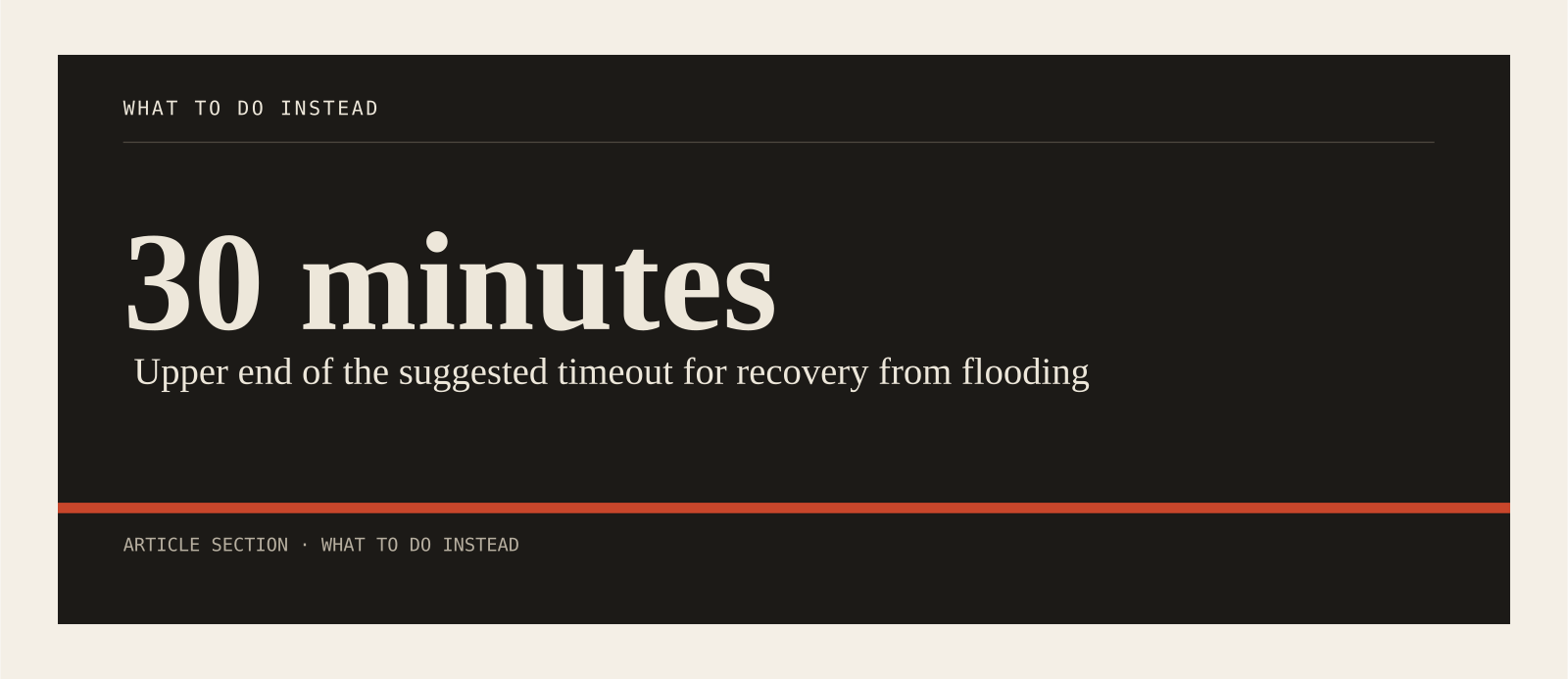
Learn to call a legitimate timeout — and use it correctly. A timeout isn't abandonment if it's handled right. That means saying, out loud, "I'm getting flooded and I can't think straight right now. I need 20 minutes to calm down and then I want to come back to this." Then actually coming back. Not after days of silence — after 20 to 30 minutes, which is roughly how long it takes the cardiovascular system to recover from flooding.
The critical part: you have to return to the conversation. A timeout that becomes a permanent shutdown is still stonewalling. The purpose of the break is recovery so you can actually engage, not avoidance.
During the break, actually regulate. Not drink. Not ruminate. Not plan your argument. Physiological self-regulation: go for a walk, do some slow deep breathing, do something distracting and low-stakes that lets your heart rate come down. Gottman's research suggests that aggressive mental review of the conflict actually prevents the physiological recovery, so distraction is better than processing during the break.
Develop your emotional vocabulary, slowly. You don't need to become someone who talks fluently about feelings overnight. Start by being able to name a few states accurately: "I feel defensive right now," "I feel like I'm being criticized," "I feel overwhelmed." Partial language is infinitely more useful than silence. Your partner can work with partial language. They can't work with a closed door.
Understand your flooding triggers. What specific topics, tones, or words from your partner reliably set off the flood? Once you can identify them in advance, you can catch the rising tide earlier — before you're fully submerged — and use the timeout before you're already underwater.
Repair attempts matter enormously. Gottman also found that in healthy relationships, partners make repair attempts during difficult conversations — small gestures or statements that interrupt the escalation. "I know this is hard." "I'm not trying to attack you." "Can we slow down?" Learning to both make and receive these attempts can break the shutdown loop before it fully sets in.
The Bigger Picture
If shutdown is a consistent pattern in your relationship — if it's happening regularly and the repairs aren't sticking — it's worth looking at the underlying dynamics rather than just the surface behavior.
Chronic stonewalling is one of Gottman's "Four Horsemen" — the relationship patterns most predictive of eventual breakdown. That's not said to alarm you. It's said because it means this is worth taking seriously as a relationship issue, not just a personal quirk.
Working with a couples therapist, or with an individual therapist who can help you understand your flooding patterns and emotional avoidance, can move things significantly faster than trying to self-correct in the middle of arguments.
If this article described your experience, Online Therapy has therapists who work with men on communication patterns and relationship dynamics. The first week is often discounted, and the work is available by text, phone, or video — you can start wherever you're most comfortable.
The shutdown has been protecting you from something. The cost is that it's also been protecting you from the relationship you actually want. There's a way through this that doesn't require you to either explode or disappear.
Evidence-based pieces on emotional fitness, by email.
No therapy-speak. No platitudes. Just the research and what it actually means for the next thing you'll feel today.
Free and occasional, no fixed schedule. Unsubscribe anytime.