
Magnesium is the supplement aisle’s comfort food. It is cheap, it sounds vaguely scientific, and the bottles promise calm and deep sleep without the baggage of a sleeping pill. If you are a guy in your forties who lies awake replaying a work conversation at 2 a.m., the pitch lands.
FREE 5-MIN ASSESSMENT
How emotionally fit are you? Most men have never measured.
So let’s do the unglamorous thing and read the actual trials. Not the brand blog posts. The randomized controlled trials and the systematic reviews that pool them. The short version: there is a real signal here, it is smaller and shakier than the marketing implies, and the form you buy matters far less than the sellers want you to believe. Where it works best is also the least exciting place: in people who were actually short on magnesium to begin with.
Start with the floor: are you even deficient?
This is the question that decides almost everything, and it is the one supplement marketing skips.
Magnesium runs hundreds of enzymatic reactions, including ones tied to the nervous system and the regulation of the stress response. If your body is genuinely short, topping it up can plausibly help. If you are already replete, adding more is mostly an expensive way to make your stool softer.
How common is the shortfall? By dietary intake, common. Using national survey data, roughly half of U.S. adults take in less magnesium than the estimated average requirement, with average intakes sitting below the recommended dietary allowance for both men and women (Advances in Nutrition, 2020). The RDA, per the NIH Office of Dietary Supplements, is 400–420 mg/day for adult men and 310–320 mg/day for women (NIH ODS).
But “low dietary intake” is not the same as “clinically deficient,” and here is a wrinkle most people never hear: the standard blood test barely tells you. Serum magnesium “has little correlation with total body magnesium levels or concentrations in specific tissues,” because most of your magnesium is locked in bone and inside cells, not floating in your blood (NIH ODS). You can have normal serum magnesium and depleted tissue stores. So when someone tells you their “magnesium levels were fine,” they are usually quoting a test that wasn’t built to answer the question.
The practical takeaway: if your diet is heavy on processed food and light on leafy greens, nuts, legumes, and whole grains, a shortfall is plausible. If you eat well, you may be chasing a deficiency you don’t have.
Sleep: a real but modest effect
This is the most studied claim, so it gets the most scrutiny.
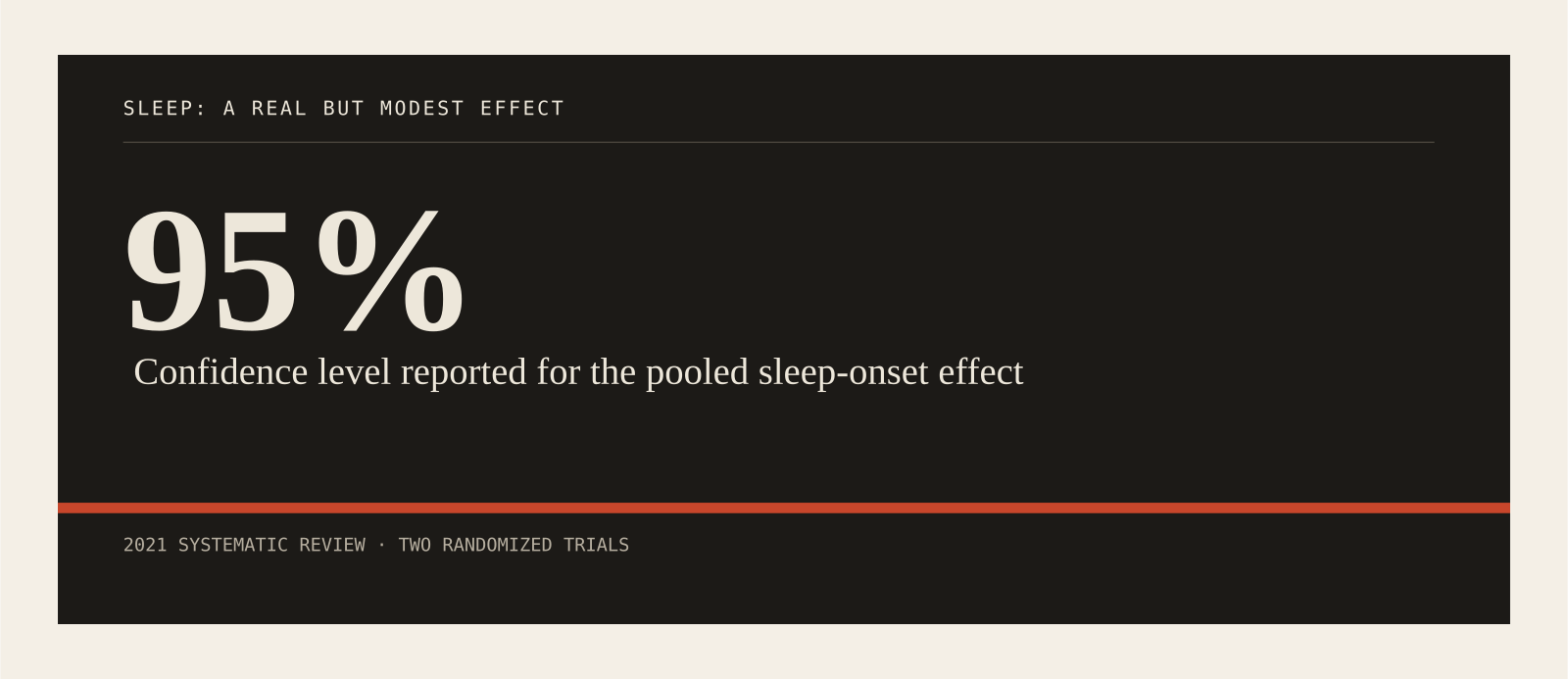
The most rigorous synthesis is a 2021 systematic review and meta-analysis of magnesium for insomnia in older adults. Pooling the randomized trials, supplementation cut the time it took to fall asleep by about 17 minutes versus placebo (95% CI roughly −27 to −7 minutes). That sounds nice until you read the authors’ own verdict. The pooled estimate came from just two trials and 55 participants total, both carried “moderate-to-high risk of bias,” and the certainty of evidence was rated low on the GRADE scale. The authors concluded bluntly that “the quality of literature is substandard for physicians to make well-informed recommendations” (BMC Complementary Medicine & Therapies, 2021).
A 17-minute head start on sleep, from low-certainty evidence in 55 older adults, is the high-water mark. That is worth sitting with.
Newer trials don’t overturn that picture; they sharpen it. A 2025 randomized, placebo-controlled trial gave 155 healthy adults reporting poor sleep 250 mg of elemental magnesium as bisglycinate before bed for four weeks. The magnesium group’s insomnia scores dropped more than placebo, but the difference squeaked past the significance line (p = 0.049) with a small effect size (Cohen’s d ≈ 0.2), and the average score at week four was still in the subthreshold-insomnia range. Outcomes were self-reported, with no objective sleep tracking (Nature & Science of Sleep, 2025). Notably, this one was funded by a university institute, not a supplement brand.
A 2024 systematic review covering both sleep and anxiety found the same texture: of eight sleep trials, five reported improvement, two found nothing, one was mixed. Most used cheap magnesium oxide. Doses ranged wildly from 100 to 729 mg. The authors’ honest summary was that magnesium is “likely useful in the treatment of mild anxiety and insomnia, particularly in those with low magnesium status at baseline” (Cureus, 2024). That italicized clause is the whole ballgame.
Anxiety: suggestive, not settled
If the sleep evidence is thin, the anxiety evidence is thinner.
The most careful review of magnesium for anxiety and stress examined 18 studies. Of eight on mild anxiety, four were positive. The authors’ summary was deliberately cautious: the data offer “suggestive but inconclusive evidence for a beneficial effect of Mg supplementation in mild anxiety,” and “the quality of studies was generally poor” (Nutrients, 2017).
The problems they catalogued are the kind that should make you suspicious of any tidy claim. Large placebo responses. Magnesium bundled with other ingredients, so you can’t tell what did the work. And a methodological own-goal: several studies used the same anxiety scale to select anxious participants and to measure the outcome, which manufactures improvement through regression to the mean. People recruited at their worst tend to drift back toward average no matter what you give them.
None of this means magnesium does nothing for anxiety. It means the honest answer is “possibly, mildly, especially if you were low, and we can’t say so with confidence.” That is a very different sentence from the one on the label.
The forms: where marketing outruns the science
Here is where the money gets made. Glycinate “for calm.” Threonate “for the brain.” Citrate “for absorption.” Oxide is the cheap one nobody brags about. How much of this hierarchy survives contact with evidence?
Oxide and citrate: the absorption question
Magnesium oxide packs a lot of elemental magnesium per pill but is poorly absorbed, which is exactly why it doubles as a laxative. Better-absorbed organic salts like citrate get more magnesium into circulation. A randomized crossover study found higher bioavailability for citrate than oxide, measured by urinary excretion and serum after dosing (BMC Nutrition, 2017), and an earlier randomized, double-blind trial in 46 adults likewise ranked citrate above oxide over 60 days (Walker et al., 2003).
So the absorption advantage of organic forms over oxide is real. What’s missing is the next link in the chain: a trial showing that the better-absorbed form produces better sleep or less anxiety. Absorbing more magnesium is a surrogate, not an outcome. And most of the sleep and anxiety trials that showed any benefit at all used oxide — the supposedly inferior form (Cureus, 2024).
Glycinate: popular, plausible, under-tested
Magnesium glycinate (bisglycinate) is the internet’s favorite for sleep, on the theory that it’s gentle on the gut and that glycine itself is mildly calming. It’s a reasonable bet, and the 2025 bisglycinate trial above is a fair-quality, non-industry data point in its favor — but the effect was small and barely significant (Nature & Science of Sleep, 2025). There is no good head-to-head trial showing glycinate beats citrate or oxide for sleep. It is preferred mostly because it’s well tolerated, which is a real and underrated virtue, just not the one the price tag implies.
Threonate: the biggest claim, the weakest receipts
Magnesium L-threonate is sold on a single, specific promise: it crosses into the brain better than other forms and therefore helps cognition, sleep, and anxiety in ways ordinary magnesium can’t.
That story traces to a 2010 rodent study in Neuron showing threonate raised brain magnesium and improved learning and memory in rats (Slutsky et al., 2010). It was a real finding. It was also in rats. No human study has ever measured whether oral threonate — or any oral form — preferentially raises magnesium in the living human brain.
And the human sleep data are actively unflattering. A 2025 randomized, double-blind, placebo-controlled trial gave 100 adults 2 g/day of branded threonate (Magtein) for six weeks. On objective sleep, measured with an Oura ring, there were no significant group differences. Only a subjective measure of sleep-related impairment edged out placebo (p = 0.043). Crucially, the trial was funded by Threotech, the company that supplied the product and helped design the study (Frontiers in Nutrition, 2026). When the maker’s own funded trial can’t move the objective needle, the “brain magnesium” pitch is doing more work in the ad copy than in the data.
Practical, evidence-weighted guidance
If you’ve read this far, you already know the honest framing isn’t “magnesium fixes sleep.” It’s “magnesium is a cheap, low-risk thing to try, with a modest and uncertain payoff, most likely to help if you were short to begin with.” With that framing:
- Fix the diet first. Leafy greens, nuts, seeds, legumes, and whole grains move your magnesium status and bring everything else those foods carry. Supplements were never meant to outrun a bad diet.
- Don’t overpay for the form. Citrate and glycinate are well-absorbed and well-tolerated and cost little. Glycinate is gentlest on the gut. Oxide is cheapest but laxative-prone — and ironically is what most positive trials used. The exotic, expensive forms are not backed by exotic, expensive results.
- Treat threonate’s brain claims as unproven in humans. You’re paying a premium for a rat study and a manufacturer-funded trial that missed its objective sleep endpoint.
- Mind the ceiling. The tolerable upper intake for supplemental magnesium is 350 mg/day for adults. Above that, diarrhea, cramping, and nausea are common, and in people with impaired kidney function magnesium can accumulate to dangerous levels (NIH ODS). Magnesium from food has no such limit; the cap is specifically for pills.
- Don’t let it crowd out what works. For persistent insomnia, the first-line treatment with the strongest evidence is cognitive behavioral therapy for insomnia, not a capsule. For anxiety that’s interfering with your life, magnesium is not a substitute for evaluation and care.
Magnesium is a sensible, inexpensive experiment with a reasonable safety margin and a real, if small, chance of helping — especially if your intake is genuinely low. That is a defensible reason to try it. It is not the same as the bottle’s promise, and the gap between those two sentences is the whole point of reading the trials yourself.
Sources
- Mah J, Pitre T. Oral magnesium supplementation for insomnia in older adults: a systematic review and meta-analysis. BMC Complementary Medicine and Therapies, 2021.
- Boyle NB, Lawton C, Dye L. The Effects of Magnesium Supplementation on Subjective Anxiety and Stress — A Systematic Review. Nutrients, 2017.
- Rawji A, et al. Examining the Effects of Supplemental Magnesium on Self-Reported Anxiety and Sleep Quality: A Systematic Review. Cureus, 2024.
- Magnesium Bisglycinate Supplementation in Healthy Adults Reporting Poor Sleep: A Randomized, Placebo-Controlled Trial. Nature and Science of Sleep, 2025.
- The effects of magnesium L-threonate (Magtein) on cognitive performance and sleep quality in adults: a randomised, double-blind, placebo-controlled trial. Frontiers in Nutrition, 2026.
- Magnesium — Health Professional Fact Sheet. NIH Office of Dietary Supplements.
- Costello RB, et al. Perspective: US Adult Magnesium Requirements Need Updating. Advances in Nutrition, 2020.
- Kappeler D, et al. Higher bioavailability of magnesium citrate compared to magnesium oxide: a randomized cross-over study. BMC Nutrition, 2017.
- Walker AF, et al. Mg citrate found more bioavailable than other Mg preparations in a randomised, double-blind study. Magnesium Research, 2003.
- Slutsky I, et al. Enhancement of learning and memory by elevating brain magnesium. Neuron, 2010.
Produced with AI under BRICK30’s editorial standards. For educational and informational purposes — not a substitute for professional medical or mental-health advice. See our Disclaimer.